Free Microsoft AI-200 Exam 2026 Practice Materials Collection [Q11-Q32]

Rate this post

Free Microsoft AI-200 Exam 2026 Practice Materials Collection

AI-200 Exam Info and Free Practice Test All-in-One Exam Guide Sep-2026

Microsoft AI-200 Exam Syllabus Topics:

Section Objectives
Develop containerized solutions on Azure – Implement containerized applications

  • 1. Manage containerized compute environments
  • 2. Deploy AI workloads in containers
  • 3. Implement scalable hosting patterns
Develop AI solutions by using Azure data management services – Work with Azure data platforms for AI workloads

  • 1. Vector databases
  • 2. Azure data management services
  • 3. Data integration for AI applications
Secure, monitor, troubleshoot Azure solutions – Operate AI cloud solutions

  • 1. Troubleshooting Azure solutions
  • 2. Monitoring and observability
  • 3. Performance optimization
  • 4. Security and secret management
Connect to and consume Azure services – Integrate Azure services

  • 1. Azure messaging and eventing
  • 2. Serverless integration patterns
  • 3. Event-driven architectures
  • 4. Azure SDKs
  • 5. Third-party SDKs


Q11. You have an Event Grid subscription that triggers an Azure Function.
You need to prevent loss of events in case the endpoint returns an HTTP 400 response.
Which action should you perform?


Q12. Hotspot Question
You are reviewing the message-processing code in a backend worker service.
You review the following Python code that initializes and starts a Service Bus processor.

For each of the following statements, select Yes if the statement is true. Otherwise, select No.
NOTE: Each correct selection is worth one point.

Q13. Drag and Drop Question
You are provisioning and configuring a Service Bus processor for AI batch jobs.
The processor must connect to an existing queue, register handlers for message and error processing, and then begin receiving messages.
You need to provision and configure the Service Bus processor for message and error handling.
Which four actions should you perform in sequence? To answer, move the appropriate actions from the list of actions to the answer area and arrange them in the correct order.

Q14. Case Study 1 – Fabrikam Inc.
Background
Fabrikam Inc. is a global retail analytics company that provides AI-driven demand forecasting and product recommendation services to online retailers. The company is modernizing its solution to run entirely on Microsoft Azure.
The platform ingests transaction data, generates embeddings for semantic retrieval, performs vector similarity search, and returns product recommendations through containerized microservices. Developers use Python and Azure SDKs. Operations teams manage container orchestration, scaling, monitoring, and security.
The solution must meet strict performance, scalability, and security requirements.
Current environment
Application architecture
The Recommendation engine is a customer-facing HTTP API running as a containerized Python application. The engine is deployed to Azure Container Apps (ACA).
Embeddings are stored in Azure Database for PostgreSQL by using pgvector.
Semantic retrieval uses metadata filtering combined with vector similarity search.
Azure Managed Redis is used as a caching layer.
Front-end and API workloads are deployed to Azure Container Apps (ACA).
Batch model retraining workloads run in Azure Kubernetes Service (AKS).
Container and CI/CD
Container images are stored in Azure Container Registry (ACR).
CI/CD uses ACR Tasks to build images on commit.
ACA environments support revision management.
AKS workloads are deployed by using Kubernetes manifest files stored in Git.
Monitoring
Logs are collected in Azure Monitor.
Teams inspect container logs and Kubernetes events when troubleshooting.
Developers write KQL queries to analyze latency spikes.
Business requirements
Customer experience: Maintain a seamless, low-latency recommendation experience for end- users, even during unpredictable seasonal traffic spikes.
Operational cost efficiency: Minimize compute expenditures by deallocating resources during periods of inactivity and by preventing runaway scaling costs.
Data integrity and freshness: Ensure that product recommendations always reflect the most current catalog metadata and pricing to prevent customer dissatisfaction.
Security and compliance: Adhere to a Zero Trust security model by eliminating long-lived credentials and centralizing the management of all sensitive secrets.
Global scalability: Support the rapid ingestion of millions of new product embeddings daily without degrading query performance for existing retailers.
Technical requirements
Performance: Semantic search latency must remain under 200 milliseconds at peak load.
Database optimization: Use pgvector for embeddings and implement metadata filtering to reduce compute overhead. Configure compute and memory appropriately for vector workloads to ensure high-dimensional index residency in RAM and efficient mathematical throughput. Vector similarity calculations must be performed only against products that satisfy mandatory metadata constraints.
Database performance: Database connections must support high concurrency with minimal latency through the implementation of connection optimization.
Data load strategy: To ensure maximum ingestion throughput, secondary indexes must be applied only after bulk loading of embeddings is complete.
Caching: Redis cache entries must expire automatically after 10 minutes. Implement a reactive mechanism to invalidate cache entries upon metadata updates.
Identity: Use managed identities for all service-to-service and service-to-database authentication.
Plain-text credentials in configuration files are strictly prohibited.
Secret management: All secrets must be stored centrally. Secrets must be rotated automatically by using a centralized lifecycle policy.
Scaling: Use Kubernetes event-driven autoscaling (KEDA) for event-driven scaling. The Recommendation API must scale based on HTTP traffic, while batch jobs must scale based on queue length and support scale-to-zero.
CI/CD: All images must be stored in Azure Container Registry. Use ACR Tasks to automate image builds triggered by source code commits.
Monitoring: Use KQL to analyze performance telemetry and troubleshoot microservice connectivity failures. Inspect logs and events when troubleshooting AKS and ACA.
You need to improve throughput for concurrent application requests to PostgreSQL. What should you implement?


Q15. Case Study 1 – Fabrikam Inc.
Background
Fabrikam Inc. is a global retail analytics company that provides AI-driven demand forecasting and product recommendation services to online retailers. The company is modernizing its solution to run entirely on Microsoft Azure.
The platform ingests transaction data, generates embeddings for semantic retrieval, performs vector similarity search, and returns product recommendations through containerized microservices. Developers use Python and Azure SDKs. Operations teams manage container orchestration, scaling, monitoring, and security.
The solution must meet strict performance, scalability, and security requirements.
Current environment
Application architecture
The Recommendation engine is a customer-facing HTTP API running as a containerized Python application. The engine is deployed to Azure Container Apps (ACA).
Embeddings are stored in Azure Database for PostgreSQL by using pgvector.
Semantic retrieval uses metadata filtering combined with vector similarity search.
Azure Managed Redis is used as a caching layer.
Front-end and API workloads are deployed to Azure Container Apps (ACA).
Batch model retraining workloads run in Azure Kubernetes Service (AKS).
Container and CI/CD
Container images are stored in Azure Container Registry (ACR).
CI/CD uses ACR Tasks to build images on commit.
ACA environments support revision management.
AKS workloads are deployed by using Kubernetes manifest files stored in Git.
Monitoring
Logs are collected in Azure Monitor.
Teams inspect container logs and Kubernetes events when troubleshooting.
Developers write KQL queries to analyze latency spikes.
Business requirements
Customer experience: Maintain a seamless, low-latency recommendation experience for end- users, even during unpredictable seasonal traffic spikes.
Operational cost efficiency: Minimize compute expenditures by deallocating resources during periods of inactivity and by preventing runaway scaling costs.
Data integrity and freshness: Ensure that product recommendations always reflect the most current catalog metadata and pricing to prevent customer dissatisfaction.
Security and compliance: Adhere to a Zero Trust security model by eliminating long-lived credentials and centralizing the management of all sensitive secrets.
Global scalability: Support the rapid ingestion of millions of new product embeddings daily without degrading query performance for existing retailers.
Technical requirements
Performance: Semantic search latency must remain under 200 milliseconds at peak load.
Database optimization: Use pgvector for embeddings and implement metadata filtering to reduce compute overhead. Configure compute and memory appropriately for vector workloads to ensure high-dimensional index residency in RAM and efficient mathematical throughput. Vector similarity calculations must be performed only against products that satisfy mandatory metadata constraints.
Database performance: Database connections must support high concurrency with minimal latency through the implementation of connection optimization.
Data load strategy: To ensure maximum ingestion throughput, secondary indexes must be applied only after bulk loading of embeddings is complete.
Caching: Redis cache entries must expire automatically after 10 minutes. Implement a reactive mechanism to invalidate cache entries upon metadata updates.
Identity: Use managed identities for all service-to-service and service-to-database authentication.
Plain-text credentials in configuration files are strictly prohibited.
Secret management: All secrets must be stored centrally. Secrets must be rotated automatically by using a centralized lifecycle policy.
Scaling: Use Kubernetes event-driven autoscaling (KEDA) for event-driven scaling. The Recommendation API must scale based on HTTP traffic, while batch jobs must scale based on queue length and support scale-to-zero.
CI/CD: All images must be stored in Azure Container Registry. Use ACR Tasks to automate image builds triggered by source code commits.
Monitoring: Use KQL to analyze performance telemetry and troubleshoot microservice connectivity failures. Inspect logs and events when troubleshooting AKS and ACA.
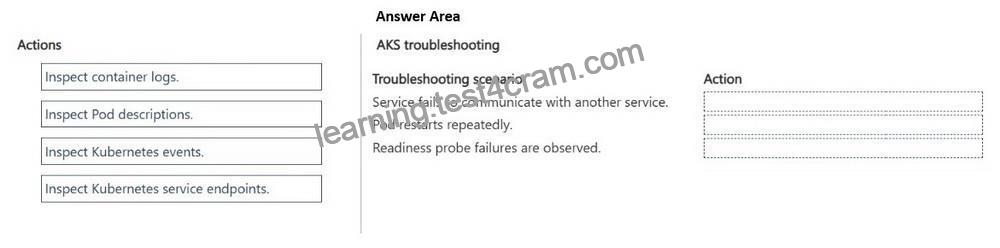
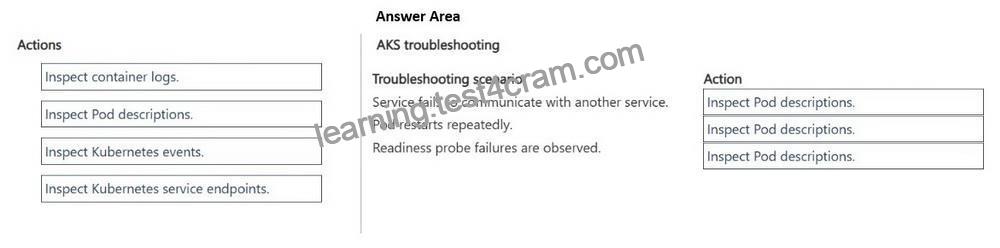
Drag and Drop Question
You need to troubleshoot connectivity failures between microservices running in AKS.
Which troubleshooting actions should you perform? To answer, move the appropriate action to the correct troubleshooting scenario. You may use each action once, more than once, or not at all. You may need to move the split bar between panes or scroll to view content.
NOTE: Each correct selection is worth one point.
Q16. You process Azure Service Bus messages that require a dependent external API call.
If the API is temporarily unavailable, you must delay processing of the message without incrementing the delivery count.
You need to find a way to process the message when the API is available while keeping the message accessible.
Which message action should you perform?


Q17. You need to translate real-time spoken customer conversations from English to Spanish text during a support call, with minimal latency. Which Azure AI service should you use?


Q18. Case Study 1 – Fabrikam Inc.
Background
Fabrikam Inc. is a global retail analytics company that provides AI-driven demand forecasting and product recommendation services to online retailers. The company is modernizing its solution to run entirely on Microsoft Azure.
The platform ingests transaction data, generates embeddings for semantic retrieval, performs vector similarity search, and returns product recommendations through containerized microservices. Developers use Python and Azure SDKs. Operations teams manage container orchestration, scaling, monitoring, and security.
The solution must meet strict performance, scalability, and security requirements.
Current environment
Application architecture
The Recommendation engine is a customer-facing HTTP API running as a containerized Python application. The engine is deployed to Azure Container Apps (ACA).
Embeddings are stored in Azure Database for PostgreSQL by using pgvector.
Semantic retrieval uses metadata filtering combined with vector similarity search.
Azure Managed Redis is used as a caching layer.
Front-end and API workloads are deployed to Azure Container Apps (ACA).
Batch model retraining workloads run in Azure Kubernetes Service (AKS).
Container and CI/CD
Container images are stored in Azure Container Registry (ACR).
CI/CD uses ACR Tasks to build images on commit.
ACA environments support revision management.
AKS workloads are deployed by using Kubernetes manifest files stored in Git.
Monitoring
Logs are collected in Azure Monitor.
Teams inspect container logs and Kubernetes events when troubleshooting.
Developers write KQL queries to analyze latency spikes.
Business requirements
Customer experience: Maintain a seamless, low-latency recommendation experience for end- users, even during unpredictable seasonal traffic spikes.
Operational cost efficiency: Minimize compute expenditures by deallocating resources during periods of inactivity and by preventing runaway scaling costs.
Data integrity and freshness: Ensure that product recommendations always reflect the most current catalog metadata and pricing to prevent customer dissatisfaction.
Security and compliance: Adhere to a Zero Trust security model by eliminating long-lived credentials and centralizing the management of all sensitive secrets.
Global scalability: Support the rapid ingestion of millions of new product embeddings daily without degrading query performance for existing retailers.
Technical requirements
Performance: Semantic search latency must remain under 200 milliseconds at peak load.
Database optimization: Use pgvector for embeddings and implement metadata filtering to reduce compute overhead. Configure compute and memory appropriately for vector workloads to ensure high-dimensional index residency in RAM and efficient mathematical throughput. Vector similarity calculations must be performed only against products that satisfy mandatory metadata constraints.
Database performance: Database connections must support high concurrency with minimal latency through the implementation of connection optimization.
Data load strategy: To ensure maximum ingestion throughput, secondary indexes must be applied only after bulk loading of embeddings is complete.
Caching: Redis cache entries must expire automatically after 10 minutes. Implement a reactive mechanism to invalidate cache entries upon metadata updates.
Identity: Use managed identities for all service-to-service and service-to-database authentication.
Plain-text credentials in configuration files are strictly prohibited.
Secret management: All secrets must be stored centrally. Secrets must be rotated automatically by using a centralized lifecycle policy.
Scaling: Use Kubernetes event-driven autoscaling (KEDA) for event-driven scaling. The Recommendation API must scale based on HTTP traffic, while batch jobs must scale based on queue length and support scale-to-zero.
CI/CD: All images must be stored in Azure Container Registry. Use ACR Tasks to automate image builds triggered by source code commits.
Monitoring: Use KQL to analyze performance telemetry and troubleshoot microservice connectivity failures. Inspect logs and events when troubleshooting AKS and ACA.
You need to optimize vector search queries based on the technical requirements. What should you do?


Q19. Your application stores conversation history so a multi-turn chatbot can reference earlier turns, but the context window is limited. You need to keep the most relevant history within token limits.
What should you implement?


Q20. You configure ACR Tasks to automate image builds.
Container images must rebuild when:
– Application updates occur.
– Base image updates occur, such as when the underlying OS image is
updated.
– Regular scheduled rebuilds are required.
You need to configure ACR Tasks to support automated image rebuilds.
Which three triggers should you configure? Each correct answer presents part of the solution.
NOTE: Each correct selection is worth one point.


Q21. Hotspot Question
You are developing a Retrieval-Augmented Generation (RAG) solution for a company.
AI responses and embedding vectors are cached in Redis.
The solution must meet the following requirements:
– AI responses must expire exactly 24 hours after they are cached.
– Cached embeddings must always reflect the current source data.
You need to configure Redis to meet the requirements.
NOTE: Each correct selection is worth one point.

Q22. You are developing an AI application. The application configuration will depend on a dynamically retrieved value of a designated key stored in an Azure App Configuration resource.
You must deploy the application to the test, staging, and production environments.
You need to be able to set the value differently in each environment.
Which feature of Azure App Configuration resource should you use?


Q23. Case Study 2 – Proseware Inc.
Background
Proseware Inc. develops AI-powered knowledge management solutions for enterprise customers.
The company is modernizing its platform to support semantic search, intelligent document retrieval, and real-time partner integrations.
The engineering team uses Python and Azure SDKs. The architecture is being redesigned to support containerized microservices, vector search workloads, and serverless backend processing.
Planned Application Architecture
Microservices are containerized by using Docker.
Code for containerized microservices and Azure Function apps is developed locally but stored in a GitHub repository.
Custom images for containerized microservices are stored in Azure Container Registry (ACR).
Base images are stored in Docker Hub. Custom images must be rebuilt automatically whenever their base images are updated.
Azure Cosmos DB for NoSQL stores documents, metadata, and vector embeddings.
Azure Functions generate vector embeddings of Azure Cosmos DB for NoSQL-hosted documents and send messages to Service Bus to trigger search index updates.
Azure Container Apps (ACA) apps host backend API services that provide semantic search across Azure Cosmos DB for NoSQL documents. API services process Service Bus messages and update search indexes.
Azure Kubernetes Service (AKS) processes batch vector embedding regeneration for existing Azure Cosmos DB for NoSQL documents (whenever the embedding model is changed).
An extranet-facing containerized webhook allows business partners to submit documents to be processed by internal AI workflows for semantic search and retrieval.
Monitoring
Telemetry generated by Azure resources is sent to Azure Monitor.
A Log Analytics workspace is used to collect ACA apps logs, AKS container logs, and Azure Functions apps logs.
Monitoring of Azure Functions is currently implemented by using Azure Application Insights SDK instrumentation.
Business Requirements
Embeddings for new or updated Azure Cosmos DB for NoSQL-hosted documents must be automatically generated.
Backend API services must scale automatically during business hours.
Cold start delay of backend APIs must be minimized.
Secrets must be stored outside of container images.
Developers must be able to correlate telemetry across Azure Functions hosts and apps.
All tracing must be implemented by using OpenTelemetry SDK instrumentation.
Development efforts must be minimized.
Technical Requirements
Container images must be built automatically and validated before code updates are merged into the main branch.
Image build automation must run inside the Azure Container Registry, eliminating dependency on local developer machines and external build services.
Dependency of image builds on local developer machines must be eliminated.
Event-driven scaling in ACA must occur based on the number of pending messages in the Azure Service Bus queue.
Azure Cosmos DB for NoSQL RU consumption must be minimized.
Vector similarity search must use embeddings stored in Azure Cosmos DB for NoSQL.
The partner-facing containerized webhook service must run on Azure App Service.
Secrets must NOT be stored in container images, source control, or application configuration directly. They must be accessed securely at runtime.
All secrets must be stored centrally in Azure Key Vault and accessed at runtime through a managed identity.
Azure App Service must supply secrets at runtime without relying on external services.
Resources and workloads must be deployed by using Bicep templates through an automated, version-controlled pipeline. Local and command-line deployments must be eliminated to ensure repeatable, auditable deployments.
Known Issues
RU consumption spikes during vector similarity queries.
You need to configure Azure Functions to generate vector embeddings according to planned environment application architecture.
Which trigger type should you use?


Q24. Hotspot Question
You are implementing semantic retrieval in Redis.
The solution must support low-latency, approximate nearest neighbor (ANN) vector similarity search for large-scale AI retrieval workloads.
You need to select the appropriate vector schema settings.
Which configuration values should you select? To answer, select the appropriate options in the answer area.
NOTE: Each correct selection is worth one point.

Q25. Your application must classify uploaded product images into one of 40 custom categories specific to your business (e.g., proprietary part numbers). What should you use?


Q26. You need to detect whether an uploaded image contains adult or violent content before allowing it to be posted to a public forum. What should you use?


Q27. You need to give an Azure OpenAI-based agent the ability to call a company’s internal REST API to check order status during a conversation. What should you implement?


Q28. Note: This question is part of a series of questions that present the same scenario. Each question in the series contains a unique solution that might meet the stated goals. Some question sets might have more than one correct solution, while others might not have a correct solution.
After you answer a question in this section, you will NOT be able to return to it. As a result, these questions will not appear on the review screen.
You plan to deploy a container to an Azure App Service API app named api1. You host the source code for api1 in a GitHub repository. The container uses the API key at runtime to connect to a backend service.
The container must be able to retrieve the API key at runtime without exposing it in the source repository or Git commit history.
You need to ensure that the API key remains outside of Git commit history and is available to the container at runtime.
Solution: Store the API key in Azure Key Vault and reference it from an App Service application setting.
Does the solution meet the goal?


Q29. Your team wants to track token usage, latency, and error rates for an Azure OpenAI-backed application in production, with alerting on anomalies. What should you configure?


Q30. You deploy a production Azure Function app that connects to an Azure SQL Database.
The solution must provide the following functionality:
– Prevent secrets from being exposed in source control.
– Support secret rotation without redeploying the function app.
– Avoid downtime during credential updates.
You need to configure secure and maintainable secret management.
What should you configure?


Q31. Hotspot Question
You are creating an app that uses Event Grid to connect with other services. Your app’s event data will be sent to a serverless function that checks compliance. This function is maintained by your company.
You write a new event subscription at the scope of your resource. The event must be invalidated after a specific period of time.
You need to configure Event Grid.
What should you do? To answer, select the appropriate options in the answer area.
NOTE: Each correct selection is worth one point.

Q32. You are choosing an embedding strategy for a RAG solution. Documents range from 2 to 200 pages. You need to preserve semantic coherence while staying within embedding model token limits. What should you do?


Pass Microsoft AI-200 Actual Free Exam Q&As Updated Dump: https://www.test4cram.com/AI-200_real-exam-dumps.html


Related Links: www.stes.tyc.edu.tw myportal.utt.edu.tt www.stes.tyc.edu.tw myportal.utt.edu.tt myportal.utt.edu.tt www.stes.tyc.edu.tw

Leave a Reply

Your email address will not be published. Required fields are marked *

Enter the text from the image below